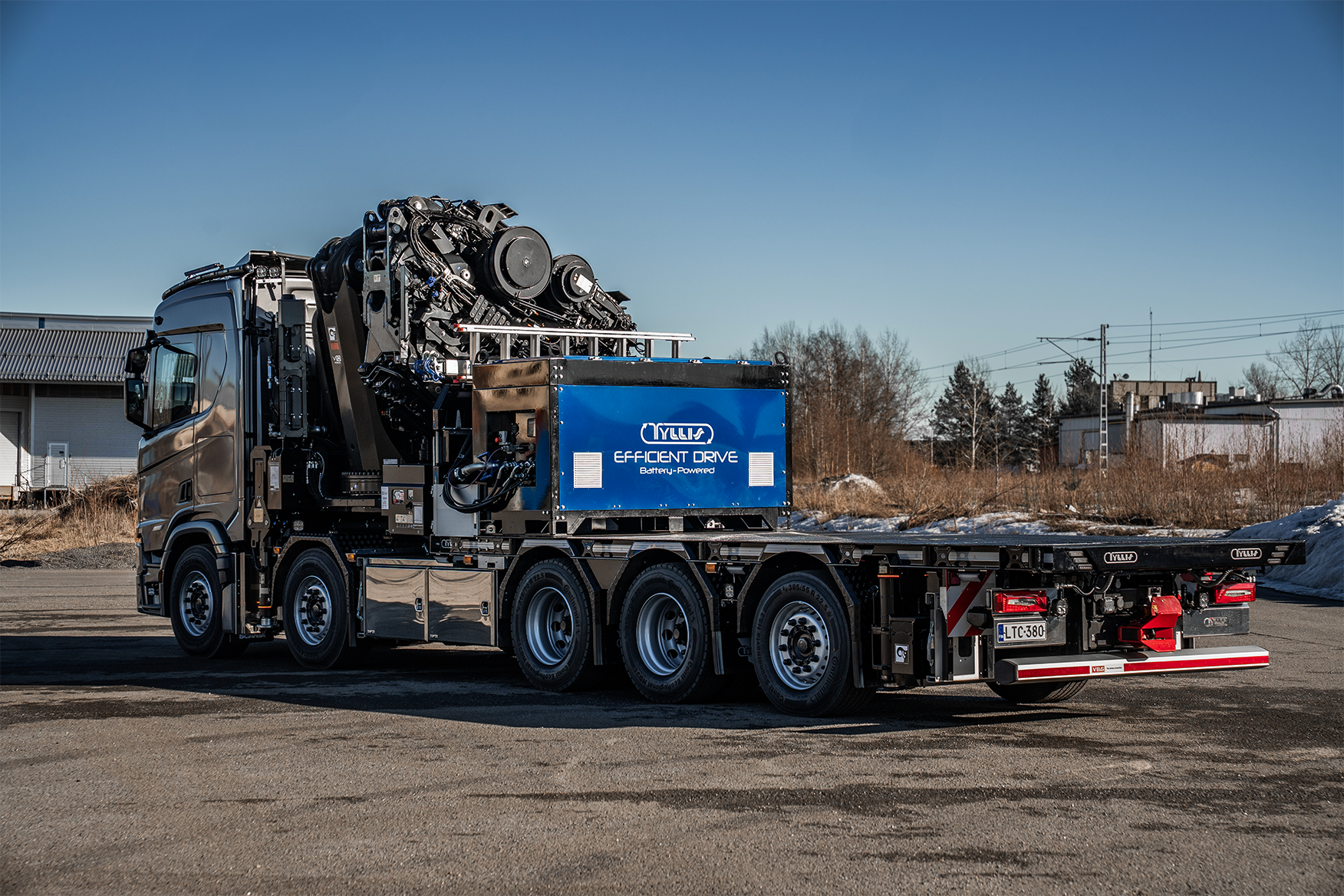
Electrification is a broad term that covers both battery-electric (BEV) and hybrid-electric powertrain solutions.
The difficult question in NRMM electrification is not whether a machine can be electrified. Almost any machine can. The key question is whether the OEM is ready to adopt electrification in its product portfolio and turn it into a reliable, serviceable and scalable product.

Before readiness comes motive. It is worth being honest internally about why the company should electrify, because the reason shapes everything that follows. The drivers tend to fall into a few groups:
Identifying the real drivers – whether regulation, customer requirements, total cost of ownership, performance, competitiveness or a combination of these – is one of the first signs that a company is ready to move forward with electrification.
Once electrification is on the roadmap, the OEM has an opportunity to reconsider design choices inherited from the diesel machine and rethink how the machine is built, powered and operated.
That may mean designing one architecture for an entire machine family instead of a single prototype. It may mean using batteries as part of the counterweight solution, combining grid and battery power to manage peak loads, or powering auxiliary functions according to actual demand rather than engine speed.
The strategic question for an OEM is therefore not only Can we electrify this machine? It is also What could this machine do better with an electrified powertrain?
These are different machines, applications and approaches to electrification. The common principle is that the work the machine does defines the system.
The most important question for the OEM to ask itself is whether it has the know-how needed to support electrification from design and engineering through manufacturing and field maintenance.
Implementing new technology in a machine requires commitment and effort from personnel at every level, from top management to designers and manufacturing staff. Management needs to make sure that the rest of the organization is set up for success. Engineering an electric powertrain requires capabilities that may not yet exist within the team.
Without electrification experience, designing and building a prototype is likely to take longer, exceed the budget and, in the worst case, fail to operate reliably. If management sees only the numbers, it may pull the plug on the project and conclude that electrification is not for the company, even when the underlying problem is a capability gap rather than the technology itself.
A useful way to approach this is to understand where the OEM’s own strengths lie and where it makes sense to seek support. The OEM is the expert in its core application technology and understands what the machine must achieve on site. Sometimes the OEM also possesses deep electrification expertise. Even then, an experienced external partner may add a new system-level perspective.
Electrification calls for a holistic approach. While selecting the right powertrain components is a critical part of the integration process, component choices should be driven by system-level requirements, not the other way around.
The OEM brings deep knowledge of the machine and its application, while an experienced system integrator complements this with electric powertrain and integration expertise gained across different machines and applications.
A diesel powertrain hides its complexity well. Externally, the system can look almost trivial: keep adding fuel to the tank, send torque, speed or power requests over the CAN bus to the ECU, and the engine takes care of the rest.
What happens inside the engine is highly complex: air intake, fuel injection, valve control, aftertreatment and control algorithms, to name a few. More importantly, the OEM rarely designs the engine itself. It buys a highly integrated system from an engine manufacturer, installs it and requests the shaft to rotate.
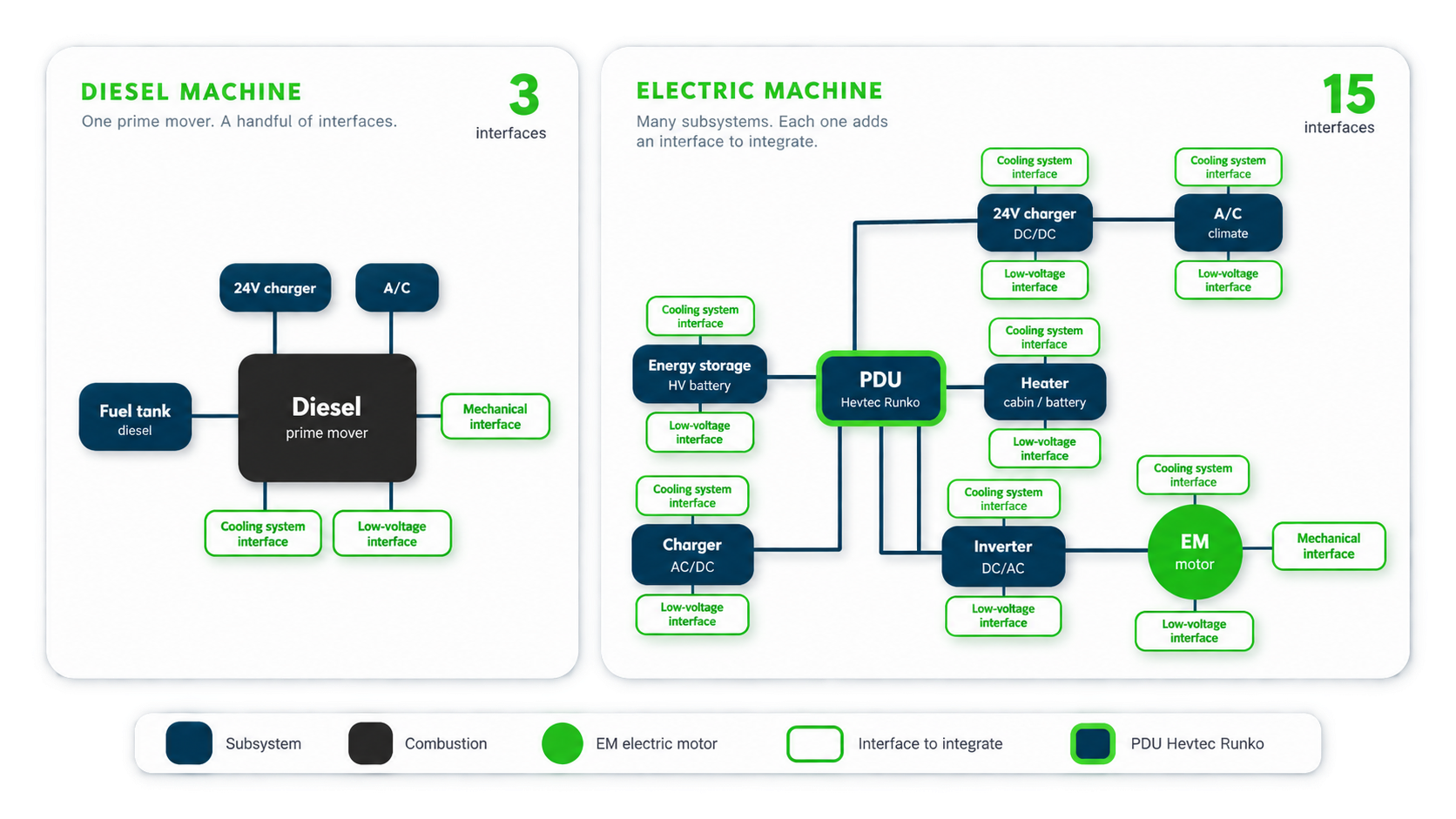
In its simplest form, an electric conversion replaces the diesel engine and fuel tank with an electric motor, inverter, battery, DC/DC converter for the 24 V system, power distribution unit and auxiliary components for thermal management. Because the battery and other powertrain components often operate in different temperature ranges, thermal management typically includes two or more coolant circuits.
Moving from a highly integrated combustion-engine system to an electric powertrain therefore replaces one packaged system with several interdependent subsystems that must be managed together: energy storage, power electronics, power distribution, controls and several cooling circuits.
Selecting components from different suppliers and connecting them may seem straightforward, but the resulting system may not operate optimally. The selected components must match each other in many ways. Voltage compatibility is one criterion; motor sizing, battery selection and thermal behavior are others.
In practice, this can show up in very concrete ways:
System integration is not magic. It requires deeper understanding at the component, control, and system levels than may be apparent at first. Just as engine manufacturers have spent years developing highly integrated products, system integrators such as Hevtec have spent years developing their electric powertrain equivalent: combining motors, power electronics, batteries and control systems into a coherent, optimized system.
Designing a single prototype to validate the technology is one thing. Designing an electric or hybrid machine as part of the product offering is another.
The OEM must consider how the machine will be built on the production line, how modularity will be handled, how service access and diagnostics will work, and how the design will scale to future machine types and sizes. A successful prototype proves that one machine can work. A production-ready design must also be repeatable, manufacturable, serviceable and supportable throughout its lifecycle.
| Readiness area | Question for the OEM |
|---|---|
| Purpose | Do we know why we are electrifying, clearly enough to explain it internally? |
| Product vision | Is the vision for this machine clear enough to guide decisions, or is it still taking shape as the project progresses? |
| Competence | Does the team understand the electric powertrain at both system and component level, or only part of it? |
| Core competence | Which parts belong to our core application expertise, and which are we attempting for the first time? |
| Technical framing | Is our team capable of framing the important questions – voltage matching, duty-cycle fit and subsystem interactions – before selecting components? |
| Industrialisation | Have manufacturing, service, diagnostics and field support been considered beyond the first prototype? |
| Scalability | Are we electrifying one machine, or building an architecture that can support a wider product family? |
Building competence takes time and finding experienced electrification specialists is not an easy task for any company. The key is to decide which capabilities should be built or acquired in-house and where hiring external expertise is more efficient use of resources.
The OEMs that progress fastest hold on to their application expertise and add system and powertrain competence for what is genuinely new, rather than trying to master the entire electric powertrain from scratch before moving forward.
If you are considering a first electrification project, an early system-level review can clarify the machine requirements, capability gaps and key architectural decisions before component selection begins.
You are currently viewing a placeholder content from Vimeo. To access the actual content, click the button below. Please note that doing so will share data with third-party providers.
More InformationYou are currently viewing a placeholder content from YouTube. To access the actual content, click the button below. Please note that doing so will share data with third-party providers.
More InformationYou need to load content from reCAPTCHA to submit the form. Please note that doing so will share data with third-party providers.
More Information