
System integration in machine electrification is the work that makes the battery, motors, inverters, controls, cooling, high-voltage system and the machine itself operate as one complete system. It begins before components are selected and continues through commissioning, testing and field support.
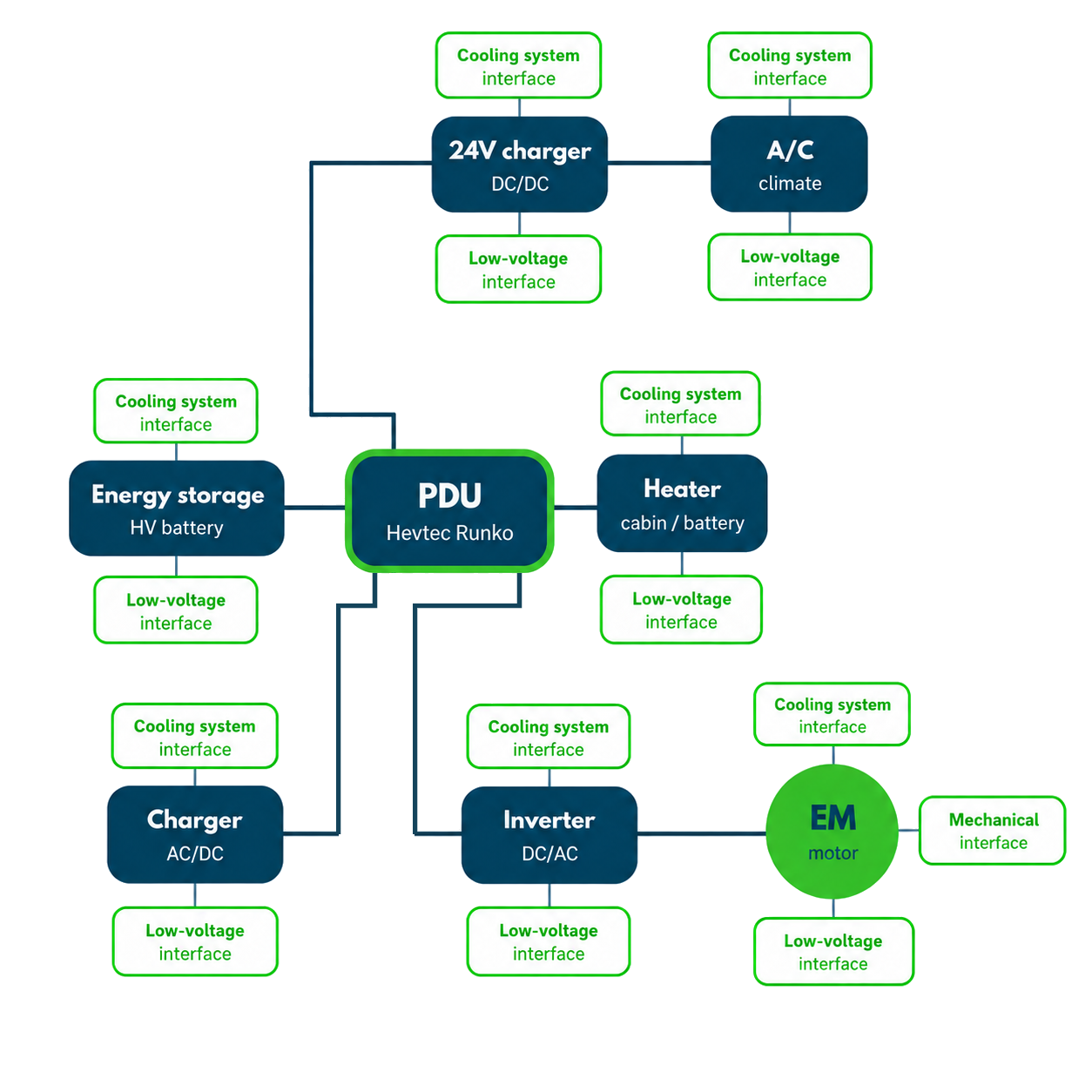
Every major component in an electric powertrain can meet its own specification and the machine can still fall short as a system.
The battery may deliver the required energy but not support the intended charging schedule. The motor and inverter may be correctly rated but poorly matched to the duty cycle. A cooling circuit may work in isolation but compete for space with hydraulic lines, high-voltage cables or service access.
These are not necessarily component failures. They are system-level problems created by the way requirements, components, interfaces and engineering disciplines interact.
A component supplier knows its own product. The OEM knows the machine and its application. System integration connects those areas of expertise and turns the individual parts into a machine that performs as intended. Whether the OEM has the internal capability to carry this work through is a separate readiness question.
System integration is broader than connecting electrical components. It covers the decisions and practical constraints that affect the complete machine.
| Integration area | What must work together |
|---|---|
| Machine requirements | Duty cycle, loads, operating environment and charging infrastructure |
| Powertrain | Battery, motors, inverters, voltage level and charging |
| Physical integration | Packaging, cooling, hydraulics, cabling and service access |
| Controls and communication | Software, component communication, diagnostics and machine control |
| Safety and validation | High-voltage safety, EMC, commissioning and system testing |
| Field operation | Serviceability, operational data, feedback and further development |
An engineering decision rarely affects only one row. Changing a battery can alter weight distribution, installation space, cooling demand, cable routing, charging time and control logic. Integration makes those connections visible before they become changes to a finished prototype.
System integration runs through the complete electrification project.
Future variants also matter. Considering modularity, component availability and charging infrastructure early can reduce redesign in later machine generations.
The sequence of the early decisions is covered in more detail in What Is Powertrain Architecture?
Electrification projects involve several suppliers and engineering teams. Suppliers are responsible for their own deliveries, while the OEM remains the machine specialist. That still leaves one question: who is responsible for the complete system?
Without clear ownership, gaps form between contracts and disciplines. A thermal issue may sit between the battery supplier, cooling design and machine packaging. Unexpected behaviour may involve an inverter parameter, control software and hydraulics. If every party focuses only on its own boundary, the overall problem can remain unresolved.
The integrator coordinates these boundaries, makes system-level trade-offs visible and remains accountable for the technical result. This complements the OEM’s expertise and gives the shared work a clear system-level owner.
A machine is not fully integrated if it performs well but is unnecessarily difficult to maintain.
A service point that looks accessible in CAD can become difficult to reach once cables, hydraulic lines, cooling hoses and surrounding structures are installed. A small packaging decision can then affect every service visit throughout the machine’s working life.
Field experience therefore matters during design. Installation order, tool access, diagnostics, replaceable components and safe isolation need consideration before the layout is fixed. Serviceability is not a finishing detail. It is an outcome of a well-integrated system.
System integration is broader than connecting electrical components. It covers the decisions and practical constraints that affect the complete machine.
If several of these are still open, that is exactly where an integrator can help.
If you are planning an electric or hybrid machine, the most useful starting point is a conversation about the machine, its operating requirements and the decisions already made.
Possibly yes, even then. A good integrator has seen many electrification projects across a wide variety of use cases, and carries silent knowledge about which components are proven in specific applications and which to avoid. Even a capable in-house team can broaden its view and increase product development speed by working with an experienced integrator.
Because system level design comes first, and component selection must support it rather than drive it. A manufacturer can confirm that a part meets its own specification, but not that it works within your machine’s duty cycle, environment, and the rest of the powertrain. The integrator owns that system level responsibility.
As early as the first architecture decisions. The earlier an integrator understands the OEM’s wider electrification roadmap, the better they can design a modular and scalable powertrain that anticipates future machines and evolving infrastructure. Bringing them in late limits how much of that thinking can still be built into the design.
You are currently viewing a placeholder content from Vimeo. To access the actual content, click the button below. Please note that doing so will share data with third-party providers.
More InformationYou are currently viewing a placeholder content from YouTube. To access the actual content, click the button below. Please note that doing so will share data with third-party providers.
More InformationYou need to load content from reCAPTCHA to submit the form. Please note that doing so will share data with third-party providers.
More Information