
Powertrain architecture defines how energy is stored, distributed, converted and delivered to the traction and work functions of an electric or hybrid mobile work machine.
A system-first approach starts with the machine’s real duty cycle and operating requirements, which guide the architecture and the component choices that follow.
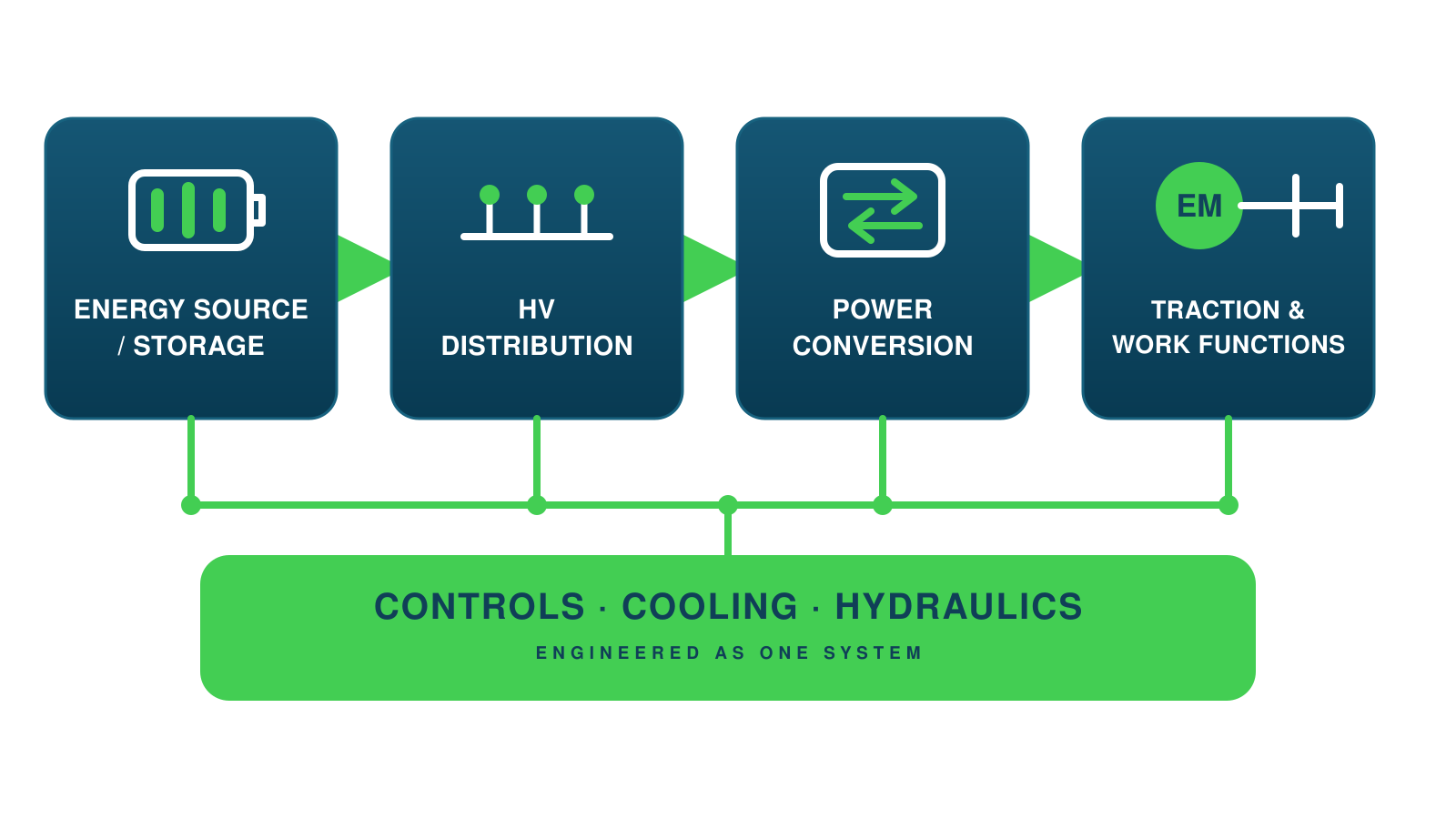
If you are planning to electrify a machine, it is tempting to begin with the battery, motor or another major component. But those choices should follow a more fundamental decision: how the complete powertrain needs to work in the machine’s real operating environment.
Component choices follow the architecture, not the other way round.
A battery-electric architecture may be the right fit when the duty cycle is predictable and charging is available. Limited access to charging may make a hybrid architecture more practical. In some applications, grid power or a combination of grid and battery power may offer another route.
The point is not to favour one architecture. It is to define the operating need first and choose the simplest system that can meet it reliably. Architecture is one part of readiness; the OEM also needs the capability to carry the machine from design through manufacturing and field support.
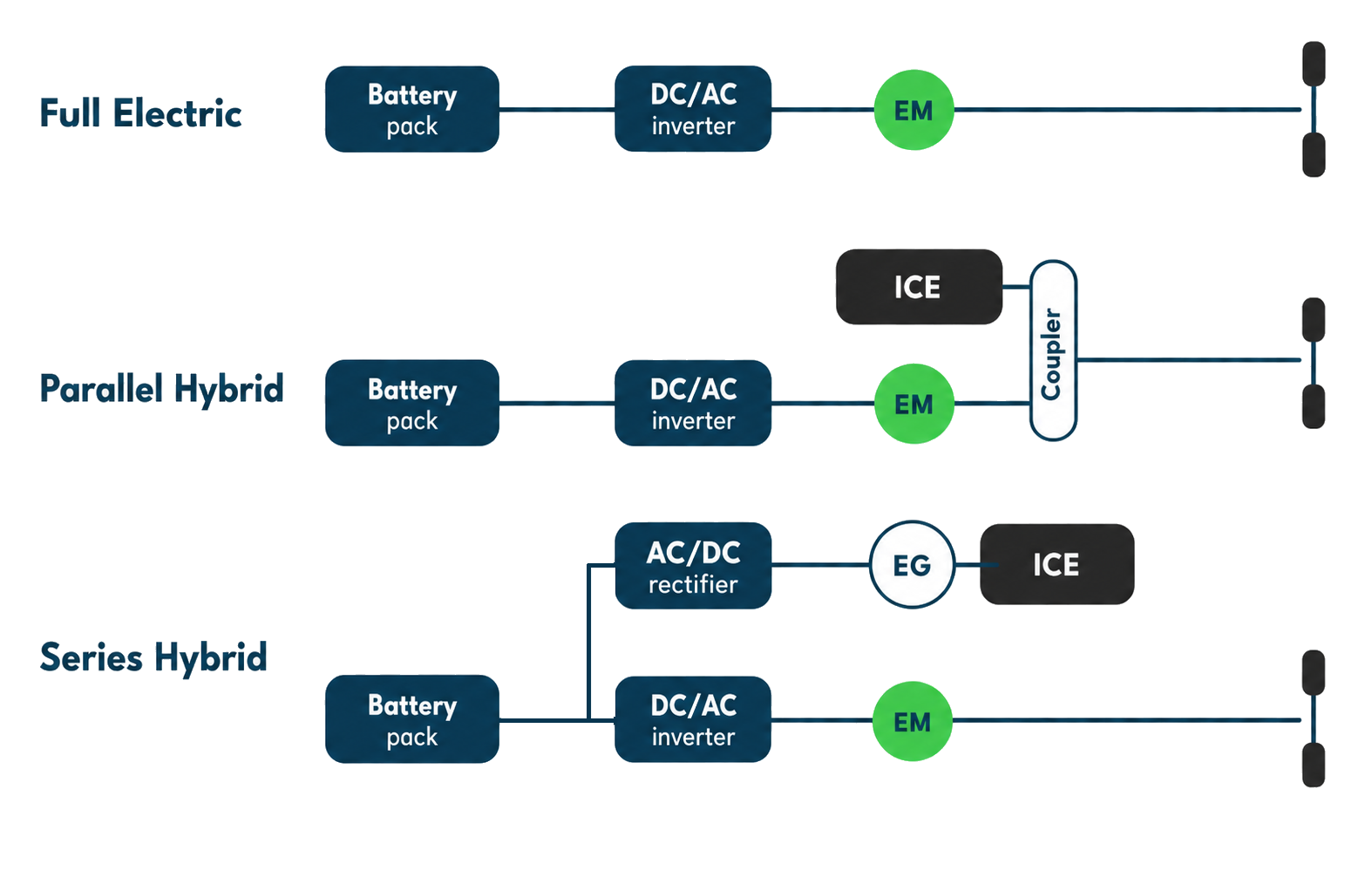
Figure 1. Simplified examples of full-electric, parallel-hybrid and series-hybrid architectures.
Component choices follow the architecture, not the other way round.
| Decision area | What needs to be defined | Why it matters |
|---|---|---|
| Operating requirements | Duty cycle, peak and average loads, work shift pattern, charging opportunities and operating conditions. | Helps prevent an oversized, undersized or poorly matched architecture. |
| Key components and lead times | Battery, motor, inverter and other components with long procurement lead times. | Early selection prevents delays to engineering, integration and the prototype build. |
| Engineering interfaces | Mechanical space, electrical routing, hydraulics, controls, cooling and service access. | Reveals integration conflicts before they become expensive and time-consuming to resolve. |
| Whole-system fit | How energy storage, power conversion, traction, work functions, charging and controls operate together. | Helps avoid unnecessary complexity, weight and cost. |
Duty cycle, peak and average loads, work shift pattern, charging opportunities and operating conditions.
Why it matters
Helps prevent an oversized, undersized or poorly matched architecture.
Battery, motor, inverter and other components with long procurement lead times.
Why it matters
Early selection prevents delays to engineering, integration and the prototype build.
Mechanical space, electrical routing, hydraulics, controls, cooling and service access.
Why it matters
Reveals integration conflicts before they become expensive and time-consuming to resolve.
How energy storage, power conversion, traction, work functions, charging and controls operate together.
Why it matters
Helps avoid unnecessary complexity, weight and cost.
Engine hours do not show how much energy productive work requires or when charging could take place. Duty-cycle data separates peak power from average energy demand and identifies realistic charging windows. Without it, teams may size the system around a worst-case assumption rather than the work the machine actually performs.
Idle time is a good example. “When we look at the work-cycle data measured from the combustion engine, the machine sits there idling for hours a day,” says Ville Eskelinen, CEO at Hevtec. That idle time is an opportunity. Those hours can become charging time, and that alone can change which architecture makes sense. A close look at how a machine really spends its day often points to a smaller battery than first assumed.
Illustrative example
Duty-cycle data separates peak power from average energy demand and shows realistic charging windows. Not measured data.
Projects run more smoothly when requirements are clear before components are locked in, long-lead items are identified early, and mechanical, electrical, hydraulic and software teams stay in active communication. Coordinating those teams and interfaces as one machine is the system integration layer. When decisions happen in isolation, conflicts appear during prototype integration: a component may fit but be difficult to service, or a battery may meet the energy target but leave too little space for cooling and other machine functions, just to name a few.
The OEM brings its machine design expertise and knowledge of how customers use and service the machine. An integration partner adds experience from other electric and hybrid applications. Together, the teams can assess architecture options against the machine’s requirements and the OEM’s plans for future models.
Who brings what
The split varies by project.
When teams are uncertain about what is genuinely needed, they tend to add capacity, components and fallback solutions as a hedge. Designing against real operating data makes it easier to remove what the machine does not need. The result can be lighter, easier to integrate and easier to maintain.
“The simpler you can keep it, the better,” says Heikki Hakala, CTO at Hevtec. Every extra component is one more thing to test, one more thing to service and one more thing that can fail.
Illustrative example
Duty-cycle data separates peak power from average energy demand and shows realistic charging windows. Not measured data.
Who brings what
The split varies by project.
“The better we understand how the machine works, where it is used and what its work cycles look like, the better we can define what it actually needs.”
Ville Eskelinen, CEO, Hevtec
Architecture does not remove every uncertainty from an electrification project. It gives the team a shared technical logic for resolving those uncertainties. Once the duty cycle, energy flow, interfaces and operating constraints are understood, component choices become clearer and trade-offs can be evaluated at system level.
That early work also creates a stronger basis for future machine variants. The same architecture may not transfer unchanged to another machine, but the decisions, interfaces and validated principles can often be reused.

If you are approaching the engineering phase of an electrification project, the right first conversation is about how the machine works, where its energy comes from and what the complete system needs to deliver. A feasibility study built on duty-cycle data turns that conversation into an independent architecture recommendation with preliminary sizing and component costs.
You are currently viewing a placeholder content from Vimeo. To access the actual content, click the button below. Please note that doing so will share data with third-party providers.
More InformationYou are currently viewing a placeholder content from YouTube. To access the actual content, click the button below. Please note that doing so will share data with third-party providers.
More InformationYou need to load content from reCAPTCHA to submit the form. Please note that doing so will share data with third-party providers.
More Information