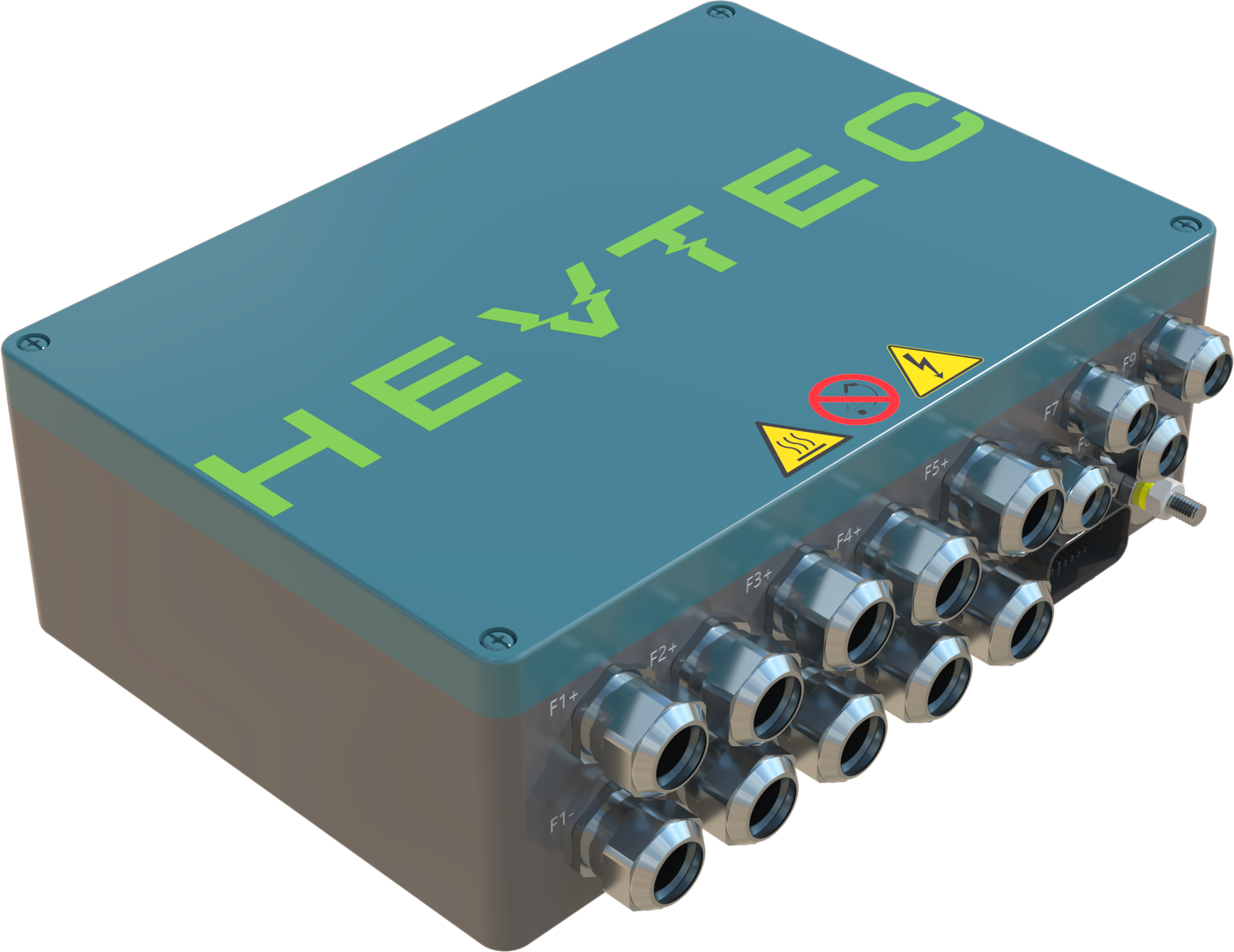
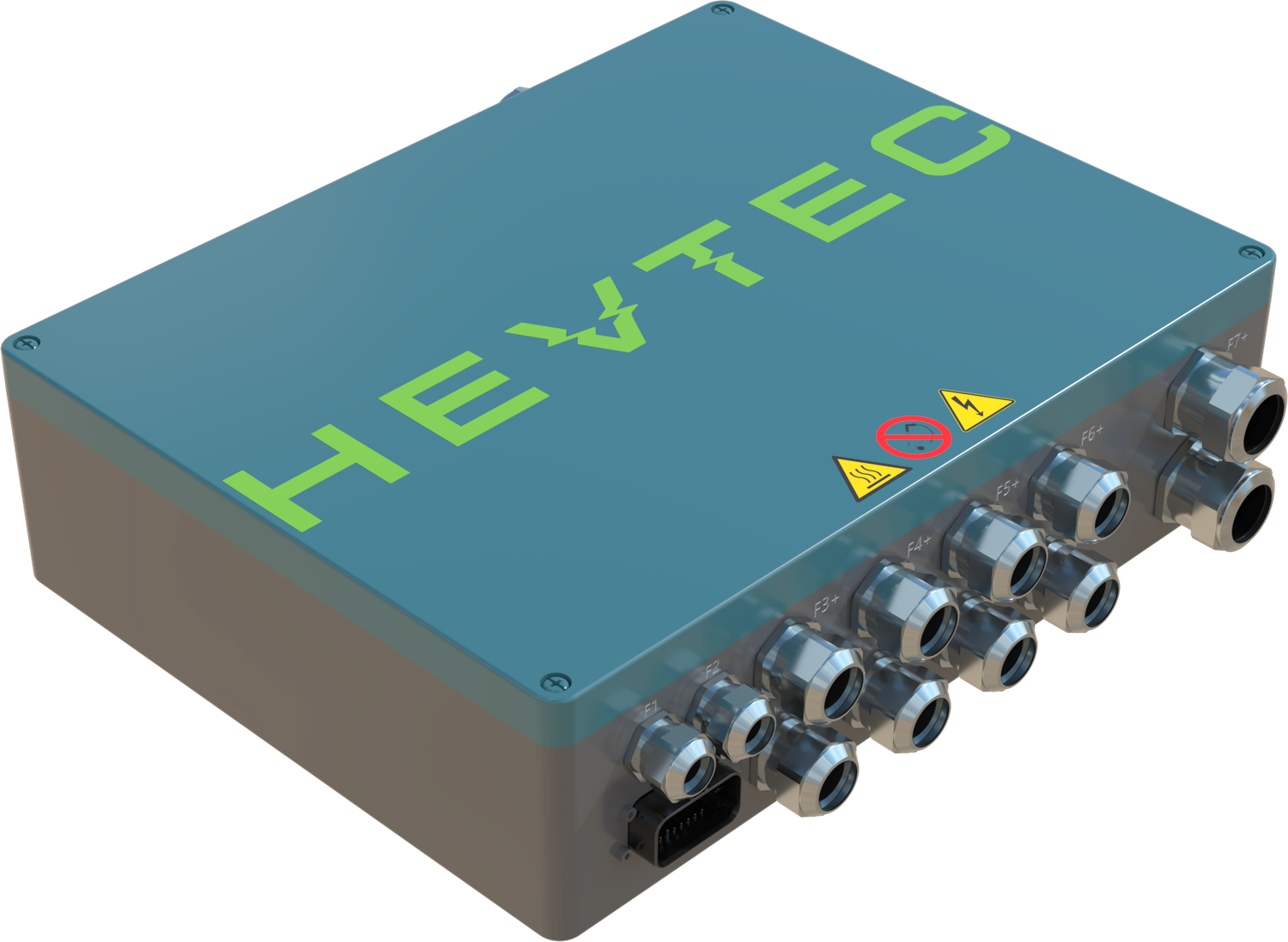
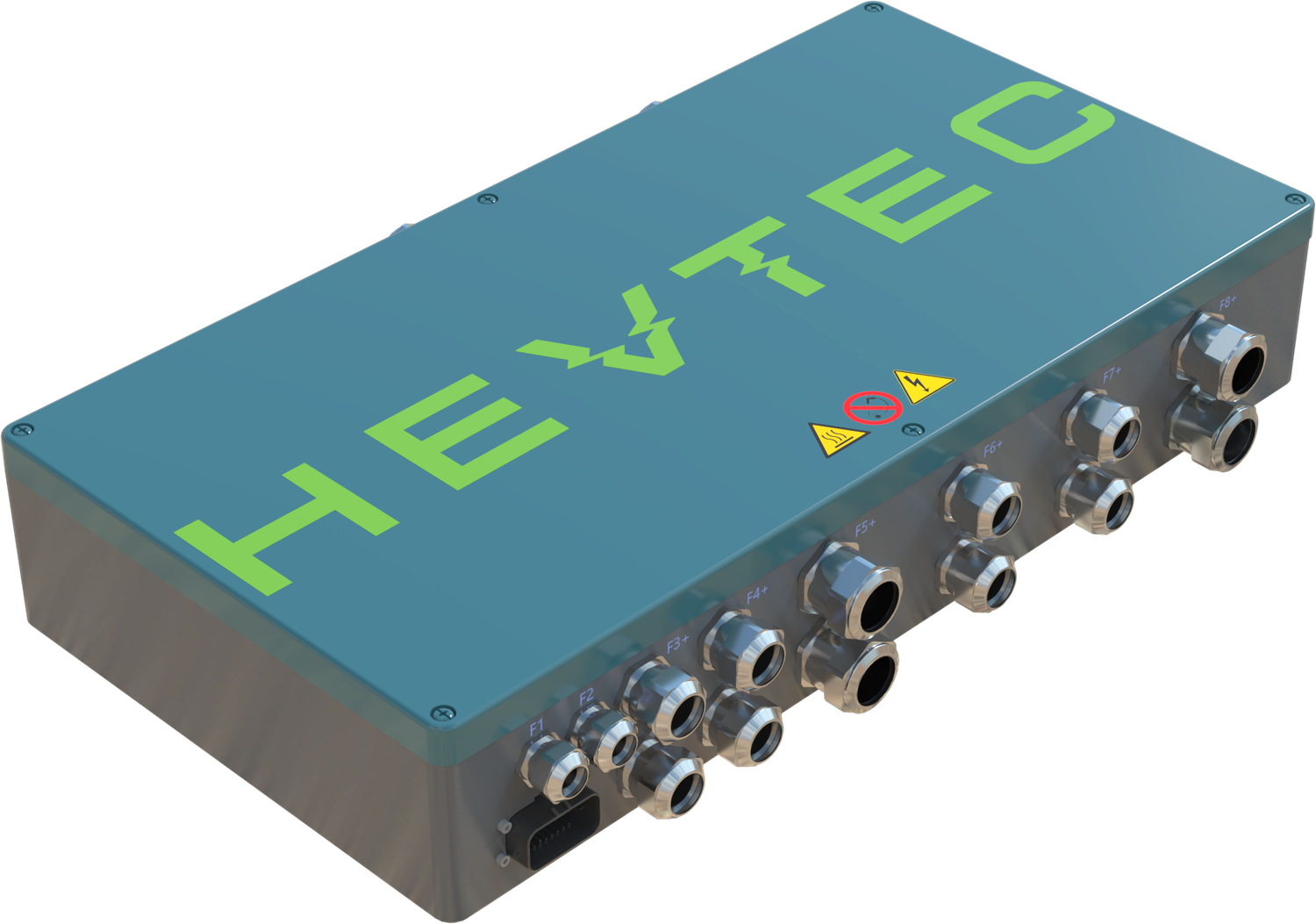
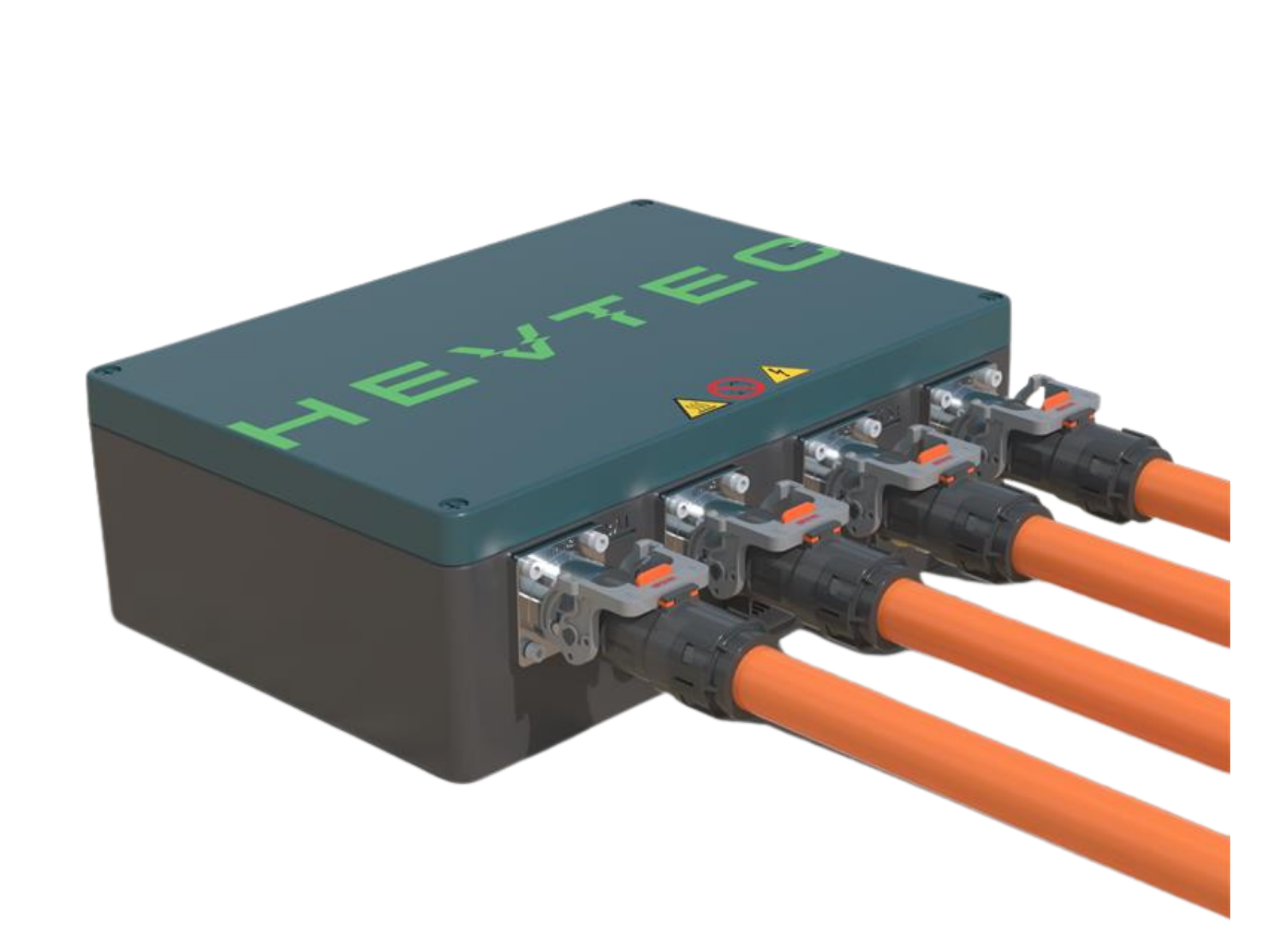
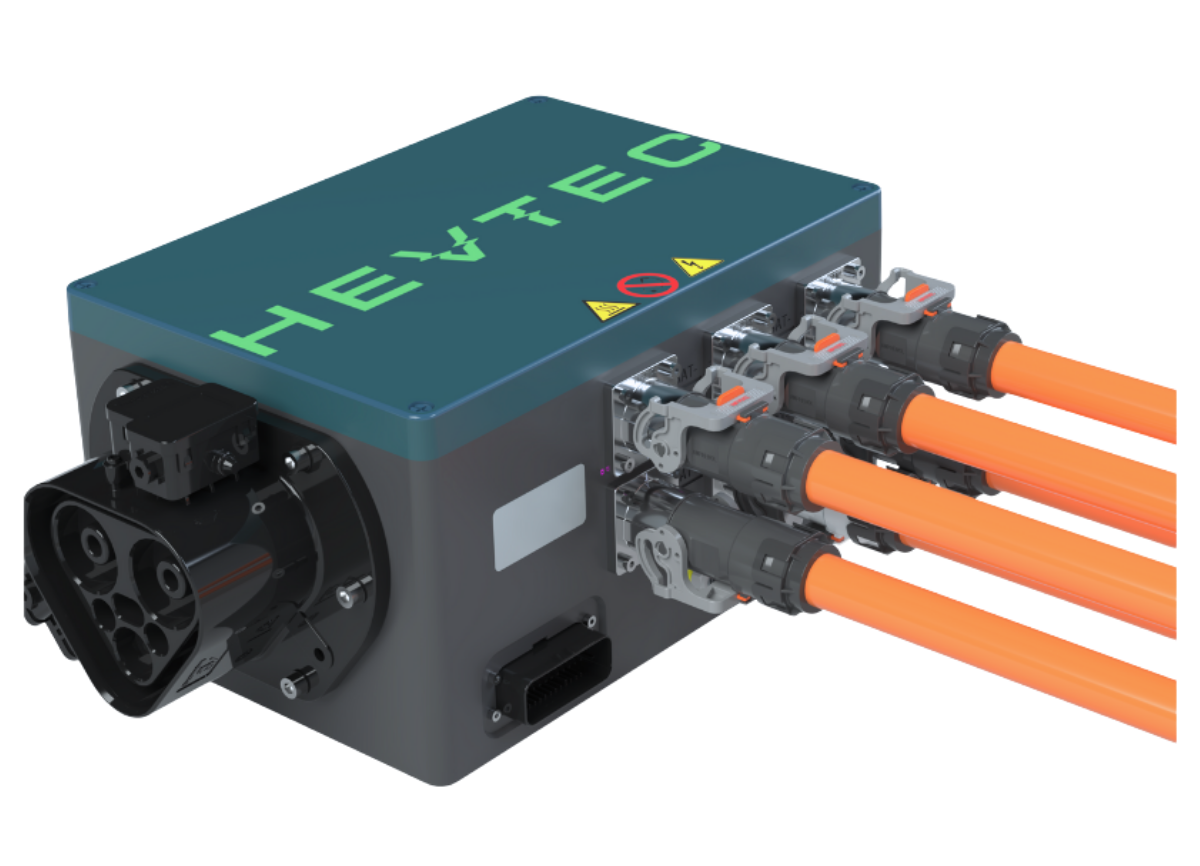
Hevtec Runko PDU: HV Power Distribution Unit for Electric NRMM
/ˈrun.ko/ — RUN-koh
Runko PDU centralizes high-voltage distribution, protection and service access into one clean unit. Available in scalable sizes S, M and L to match different machine classes and architectures.
Runko PDU-L Specifications
System voltage
1000 V
Rated current
750 A, sum (*)
Peak current
1500A (*)
Protection class
IP67
IK09
Insulation Monitoring
Yes - Optional
Connection type
EMC cable glands
Other features
Interlock switch, Temperature sensor
Dimensions
W x L x H
600 x 310 x 111 mm
Weight
12 kg
Fuse sizes
4x 70 - 800 A
3x 70 - 400 A
5x 70 - 200 A
4x 5 - 60 A
*Dependent on ambient temperature
Runko PDU datasheets
Full technical datasheets are now available for every Runko size. Each sheet lists the voltage and current ratings, fuse configuration, connection interfaces, dimensions and environmental limits, so your team can check fit against the machine before the first conversation.
Runko supports both MCS and CCS charging
- Runko PDU Size S (CCS charging, available A-sample stage) Download datasheet
- Runko PDU Size M (CCS charging, available A-sample stage) Download datasheet
- Runko PDU Size L (MCS and CCS charging, available A-sample stage) Download datasheet
Built for prototypes and small-series builds
Most HV connector combinations are hard to source. Hard-to-source HV connector combinations add cost and lead time, because different connector brands often require different tooling and sourcing. By standardizing HV connectors, you keep cable-gland HV cabling agile and repeatable from prototype to small series.
RUNKO PDU is built to keep that part simple,
Easy-to-source HV connectors, only one end needs to match the device, other end flying lead
Using standard cable lugs
Scalable fuse positions for multiple HV loads (sizes S, M, and L)
Add outputs as requirements evolve
Access-friendly design for faster commissioning and troubleshooting
Centralized HV Distribution (PDU) Benefits
-
Clean HV architecture: centralized two sided distribution and fusing reduces cabling complexity
-
Service-friendly layout: protection and service access in one place for faster troubleshooting
-
Integration-ready packaging: clear interfaces that are easier to document and maintain
-
Safety-ready interfaces: supports interlock/HVIL integration as part of operation and service design
-
Scalable outputs: Size-dependent fuse positions for multiple HV loads
Why does Runko use EMC cable glands instead of quick HV connectors?
In a prototype you rarely know the exact cable lengths up front. The layout is still moving, components shift, and the harness is not final. Quick HV connectors are a good choice in series production, but early on they slow you down: you need the right connector, the cable cut to an exact length, and those connectors can be hard to source.
Runko uses EMC cable glands instead. Only the device end needs a matching connector, the other end is a flying lead, so there is less to source before you start assembly. You run the cable and cut it to length on the machine, and when the layout shifts, the cabling moves with it with no waiting on parts. For series production, quick connectors remain a valid option.
When will Hevtec’s Runko PDU be available, and what sizes will it come in?
Runko PDU product series has been finalized in three sizes: S, M and L. First prototypes will be piloted together with the Koski MCS interface in Q3/2026.
Why is the PDU a critical part of NRMM electrification integration?
A PDU is the machine’s high-voltage “power hub.” It connects the battery and electric components, distributes power to loads, and protects the system with built-in safety and protection functions—making the HV architecture clearer, safer, and easier to service.
How does a PDU improve integration and serviceability in electrified heavy machines?
A PDU centralizes high-voltage distribution and fusing into one clear unit. This reduces wiring complexity, makes interfaces easier to service, and speeds up commissioning and troubleshooting.
How do I size the fuses?
Fuse sizing depends on ambient conditions, load profile, and component limits. Don’t worry — our team can help you size and validate the protection correctly.
Electrification rarely fails on a component. It fails on integration. If you’re unsure about HV distribution, fusing or interfaces, let’s review your system and integration plan. Talk to an engineer.