
Two electrification kits can have the same voltage, peak power and list of main components, yet behave very differently once installed in a machine. One may match the real workload, fit the available space and support the required charging cycle. The other may meet the headline specifications but create compromises in runtime, efficiency, cooling or service access.
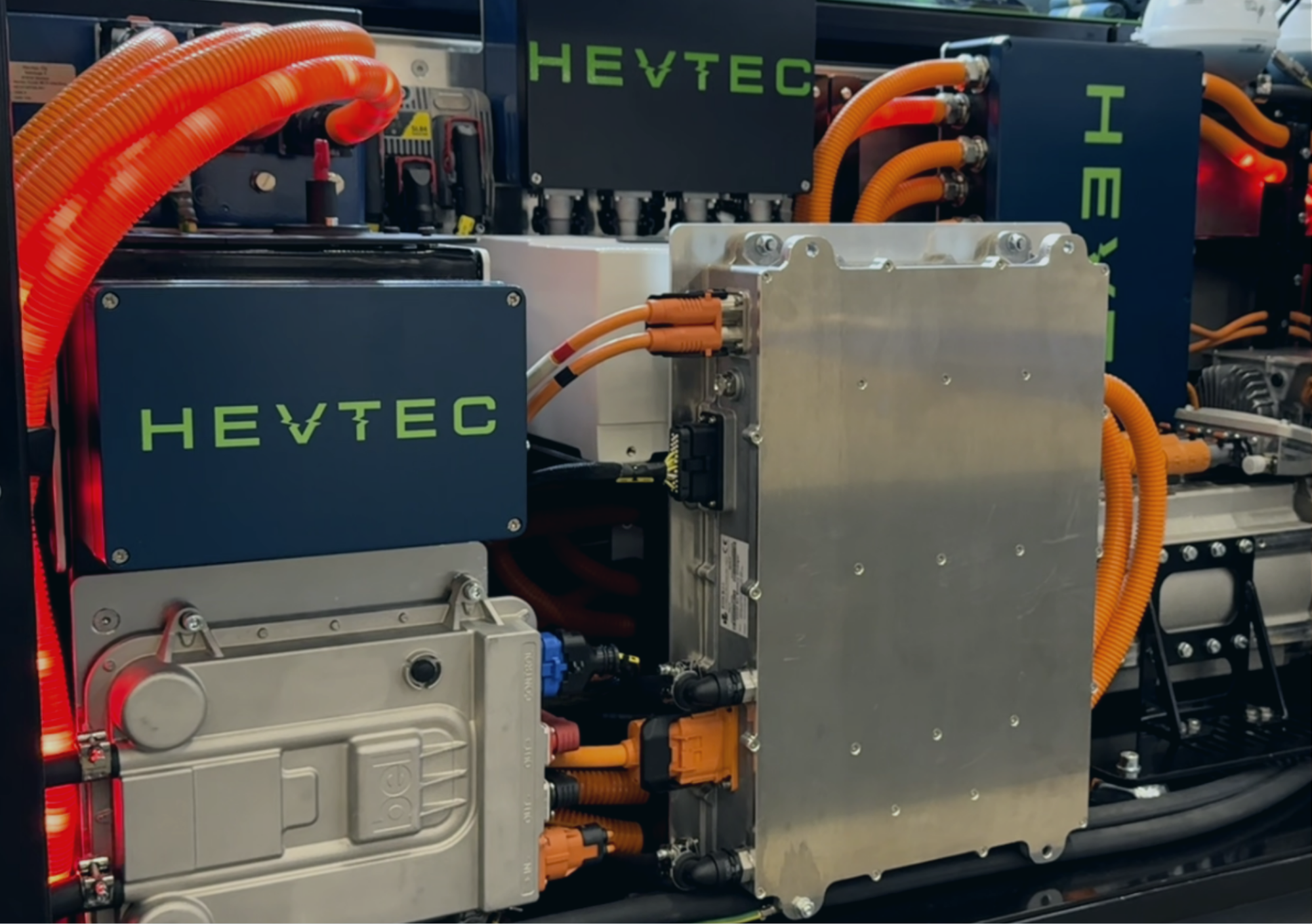
The important question is therefore not whether an electrification kit for heavy machinery contains all the expected components. It is whether those components have been selected and configured around the machine’s duty cycle, operating environment, charging strategy, packaging constraints and performance targets. A suitable kit works as one integrated and supportable system, not simply as a component list.
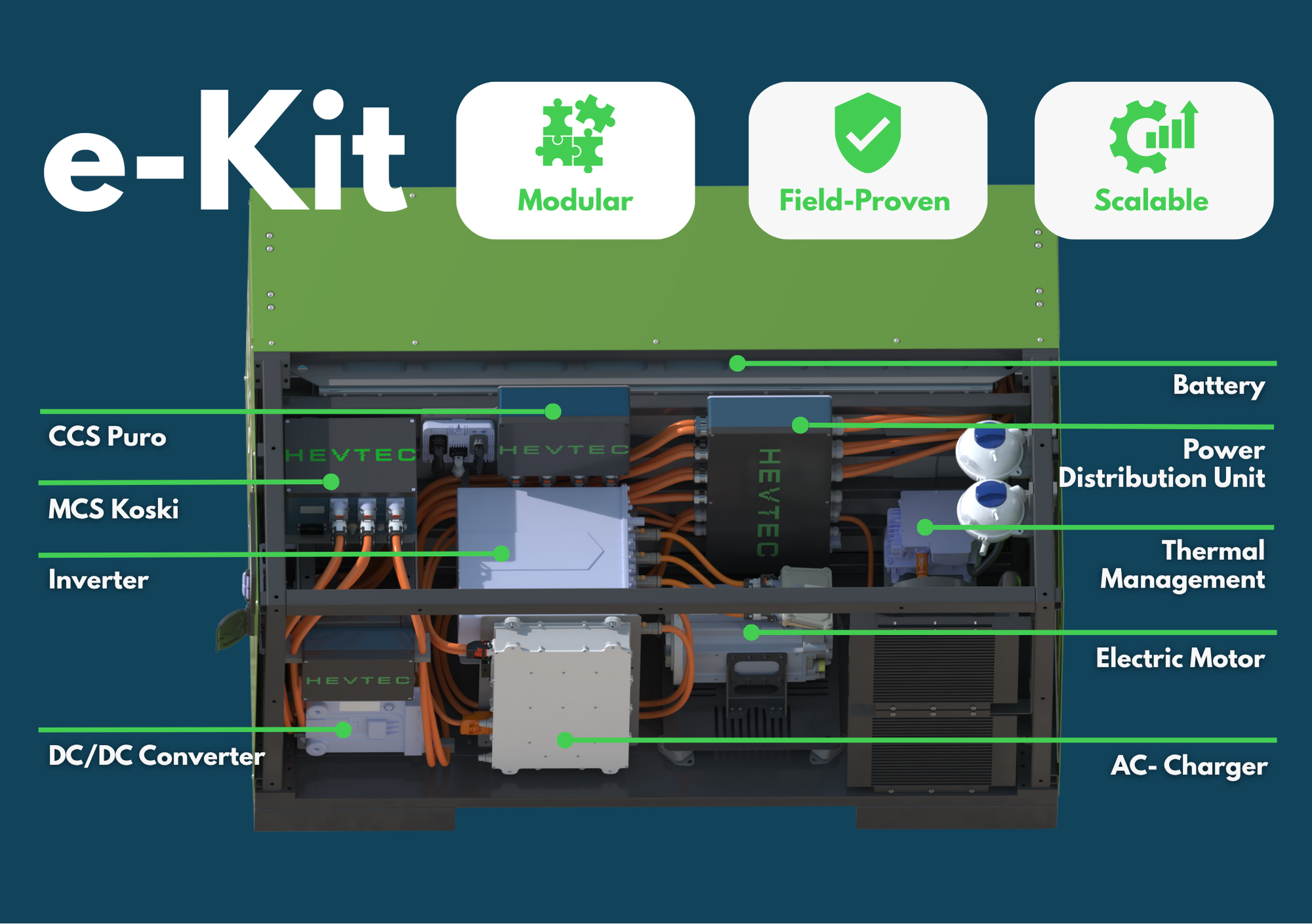
An electrification kit combines the powertrain hardware and software needed to build a battery-electric or hybrid machine. Depending on the application, it can include electric motors and inverters, battery systems, AC or DC charging, DC/DC converters and auxiliary power supplies, cooling and thermal management, high-voltage distribution and protection, as well as control software, diagnostics and machine interfaces.
The components matter, but the interfaces between them matter just as much. Voltage levels must align, charging must fit the working day, cooling must suit the operating environment and software must coordinate the system predictably. That is the difference between a component package and a powertrain system.
Peak engine power alone does not describe what an electric machine needs. Two machines with the same nominal power can have very different energy use, load peaks, idle periods and charging opportunities. Before selecting a kit, the OEM should understand:
average and peak power demand
energy use during a representative shift
the duration and frequency of load peaks
operating hours and idle periods
available charging windows and charging power
ambient temperature, dust, water, vibration and shock loads
Without this information, additional battery capacity or motor power may be used as a general safety margin. That can increase cost, weight, cooling demand and packaging difficulty without improving real performance.
| Decision area | What should determine it | Risk if ignored |
|---|---|---|
| Architecture | Duty cycle, performance targets and the machine’s operating model. | Components begin to shape the system before the actual requirements are clear. |
| Motor and inverter | Speed, torque, load peaks and the machine’s most common operating points. | The drivetrain may spend too much time outside its efficient operating range. |
| Battery and charging | Energy demand, power peaks, charging windows, temperature and available installation space. | Runtime, charging performance and battery size may not align with daily operation. |
| Packaging and cooling | Machine geometry, thermal loads, cabling, hydraulics and service access. | Components may fit in CAD but become difficult to install, cool or maintain. |
| Controls and diagnostics | Machine functions, safety requirements, component interfaces, diagnostics and software ownership. | The system may become difficult to manage, diagnose or change after the first prototype. |
| Scalability | Future machine variants, component families and production plans. | Architecture and integration work may need to be repeated for every new machine variant. |
A component can meet the nominal specification and still be a poor match for the machine. For example, we have seen electrification kits in which the inverter and motor were selected to handle more than 250 kW of continuous power, even though the same setup was used in machines requiring only 80 kW. Although the components were technically capable of doing the job, the mismatch compromised the efficiency of the electric powertrain.
Motor selection is not only about meeting the required power level. Selecting the wrong motor winding can reduce powertrain efficiency by more than 10 percent, while a correctly matched configuration can reach up to 96 percent efficiency. What matters is where the machine operates during its actual duty cycle, not only the maximum value shown on the datasheet.
We have also seen significant differences between battery solutions that appeared nearly identical on paper. Similar voltage, capacity and power ratings do not guarantee similar performance under repeated power peaks, fast charging, low temperatures or other real operating conditions.
The battery system is commonly the most expensive component in a battery-electric or hybrid powertrain. Selecting a technically compatible but poorly matched battery can therefore become a costly mistake. This is why kit evaluation should go beyond headline specifications and consider how the complete system performs in the machine’s actual duty cycle.
Modularity should not mean forcing every machine into one fixed package. A modular electrification kit should provide:
proven building blocks and component interfaces
a repeatable control and communication architecture
configurable motor, battery and charging options
scalable high-voltage distribution and protection
integration and service documentation
a clear boundary between what is ready and what must be engineered for the application
This preserves the value of standardisation while allowing the system to fit the machine. The objective is to avoid starting from zero without hiding application-specific engineering behind the word “kit”.
Two reference projects show what this means in practice. The Junttan PMx4e scalable electrification platform demonstrates how a proven architecture can grow in power, energy and capability without redesigning the core system. Geoelectric MTG-e e-Kit reference shows how a scalable system can be configured around the machine’s real duty cycle, charging requirements and operating conditions.
What duty-cycle data was used for sizing?
Where will the motor operate on its efficiency map during normal work?
How were the battery and charging strategy selected?
Which parts are already validated, and in what conditions?
What remains application-specific engineering?
How will the system be packaged, cooled and serviced?
Who owns the control software and documentation?
Can the architecture support future machine variants?
Clear answers to these questions reveal more about the suitability of a kit than a long list of available components.
An OEM looking for a complete, configurable powertrain system can start with the Hevtec e-Kit. An OEM with its own engineering team may instead need targeted support through Fast Track Services.
If the right architecture or kit configuration is not yet clear, a Solution Assessment provides a structured path from a technical discovery call through requirements and duty-cycle analysis and component and supplier mapping to a final recommendation package.
Because the drivetrain operates away from its most efficient region, increasing losses and heat, especially in the most common operating range.
Chemistry impacts charge performance, cold/heat behavior, lifetime, safety margins, and packaging needs. Often more than spec sheets suggest.
You are currently viewing a placeholder content from Vimeo. To access the actual content, click the button below. Please note that doing so will share data with third-party providers.
More InformationYou are currently viewing a placeholder content from YouTube. To access the actual content, click the button below. Please note that doing so will share data with third-party providers.
More InformationYou need to load content from reCAPTCHA to submit the form. Please note that doing so will share data with third-party providers.
More Information